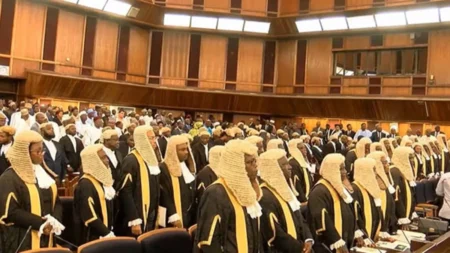








Human rights lawyer, Femi Falana (SAN), has threatened to drag the Federal Government to court over the construction of luxury houses for judges by the Federal Capital Territory (FCT) Administration.
Falana described the move as unconstitutional and capable of undermining the independence of the judiciary.
The FCT Minister, Nyesom Wike, had earlier flagged off the construction of 40 judges’ quarters in the Katampe District of Abuja. The houses are to be allocated to judges of the Federal High Court, FCT High Court, Court of Appeal, and Supreme Court.
The project, which was approved by the Federal Executive Council, has generated controversy, with critics arguing that it amounts to the executive arm of government gifting judges with expensive properties.
Speaking on Channels Television’s Politics Today, Falana argued that the FCT Minister, by virtue of Section 299 of the Constitution, operates like a state governor whose powers and budget are limited to the administration of the Federal Capital Territory.
He maintained that the Minister has no constitutional authority to build and allocate houses to judges serving in federal courts such as the Federal High Court, Court of Appeal, and Supreme Court.
Falana further warned that the gesture creates a conflict of interest, noting that the FCT Minister has several cases pending before these courts.
“You cannot be seen to be giving cars or houses to judges who are going to determine your cases,” he said.
He insisted that if judges require accommodation or other welfare packages, such provisions should be handled by the National Judicial Council (NJC) through its own budget, in line with the constitutional guarantee of judicial autonomy.
Falana stated that he would not hesitate to approach the court to challenge the constitutionality of the project if the government proceeds with it. He described the arrangement as an embarrassment to the judiciary and a violation of the principle of separation of powers.
The FCT Minister’s media team has defended the project, arguing that there is nothing wrong with the government providing decent accommodation for judges. They noted that judges, like other public officials, require proper housing to perform their duties effectively.
The controversy has continued to generate public debate on judicial independence and the relationship between the executive and judicial arms of government.