



Operatives of the Economic and Financial Crimes Commission (EFCC) have arrested Nigeria’s former Minister of Power, Saleh Mamman. The arrest follows his recent conviction and 75-year prison sentence, which was handed down in absentia for his role in a N33.8 billion ($24.7 million) hydropower project fraud.
Mamman, who served under former President Muhammadu Buhari from 2019 to 2021, was apprehended at approximately 3:30 a.m. on Tuesday in the Rigasa area of Kaduna State.
Key Details of the Case and Arrest
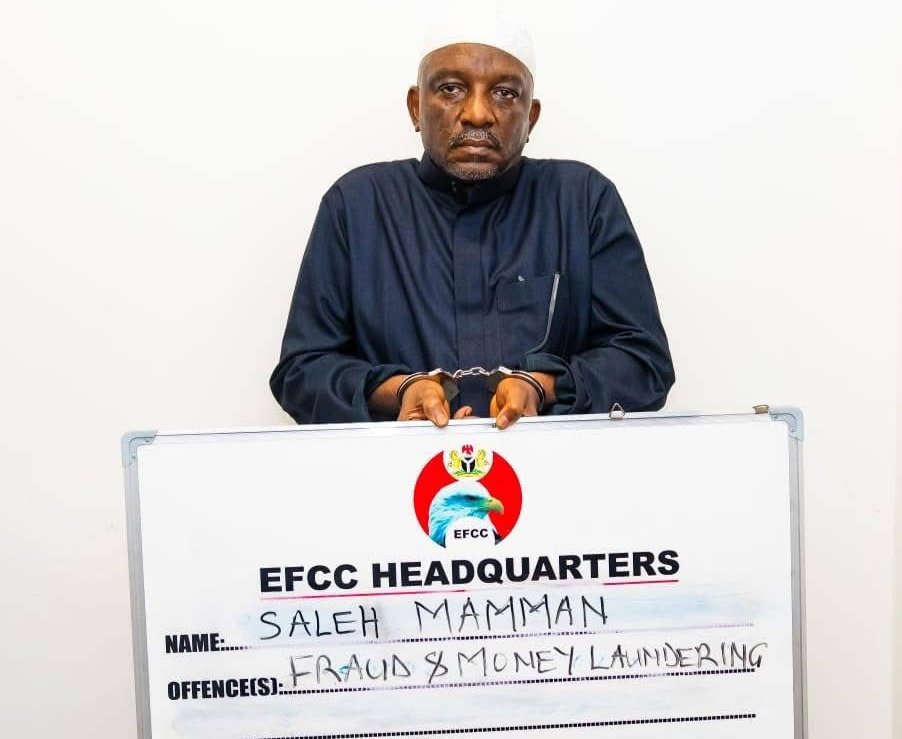
- The Arrest: EFCC Chairman Ola Olukoyede confirmed that Mamman was taken into custody and transferred to Abuja. Two individuals suspected of harboring the fugitive minister were also detained. Images of a handcuffed Mamman holding an arrest board have since circulated on social media.
- The Charges: The conviction concludes a lengthy investigation that began shortly after Mamman left office in 2021. He was formally arraigned in July 2024 on 12 counts of money laundering and conspiracy.
- The Fraud: Prosecutors proved that Mamman and other ministry officials diverted billions of Naira earmarked for the Zungeru and Mambilla hydroelectric power projects—critical infrastructure meant to address Nigeria’s electricity shortages—into private corporate accounts.
The Verdict and Sentencing
On May 7, 2026, Justice James Omotosho of the Federal High Court in Abuja found Mamman guilty on all counts. Because the former minister went into hiding, the trial and subsequent sentencing on May 13 proceeded in absentia under the Administration of Criminal Justice Act.
Sentence Breakdown: The court imposed consecutive seven-year terms on the majority of the counts, alongside shorter terms for the remaining charges, totaling 75 years in prison without the option of a fine.
Justice Omotosho ordered that the 75-year prison term commence immediately upon Mamman’s arrest. The court also mandated the forfeiture of all recovered assets and ordered the repayment of the remaining unrecovered funds.
Public Impact
The high-profile arrest has reignited intense public debate regarding systemic corruption within Nigeria’s power sector. While many citizens have praised the development as a significant victory for accountability and a stern warning to public officials, others are questioning whether investigations will expand to include other high-ranking individuals.
The EFCC has stated that asset tracing remains ongoing, marking this as one of the most high-profile corruption convictions of a former federal minister in recent Nigerian history.